 |
Benitz Family Roots | Page last modified: |
|
Benitz Family Roots | Page last modified: |
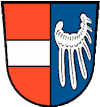
Endingen am Kaiserstuhl
General background of the family’s 19th
century roots in the village of Endingen-im-Breisgau, Grand Duchy
of Baden:
— Evolution of the family name,
— Given names,
— Family Religion,
— Endingen (a Badische village),
— Social Structure in a Badische village.
————«♦»————
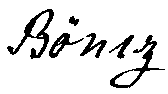
Wilhelm Benitz
baptism record
1815
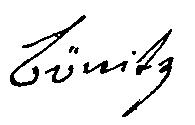
Thaddeus Benitz
marriage, 1836
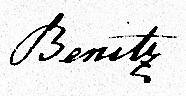
Wilhelm Benitz
signature, 1837
Jochen Bonitz, in his comprehensive Bonitz Forum website, provides some possible clues to the meaning or root of the Bönitz surname. In Endingen (the ancestral home village of greatest interest to this website), Benitz evolved from Böniz / Bönitz.
Böniz / Bönitz to Benitz: Prior to about 1840 the spelling of the family surname in Endingen varied according to its pronunciation and the whims of the church record keepers. German is a phonetic language and its spelling was not standardized until the early 19th century when many adopted Goethe's spelling. It is also very likely our ancestors at that time were illiterate and, therefore, had no standard spelling. During the early 1800's the spelling was more varied, including: Böniz, Bonitz, Bönitz, Boeniz, Boenitz, and Beniz - the German ö sounds similar to a deep English e, almost like u, somewhere between Beun-it's and Burn-it's. During the period 1830-1840 the surname of our ancestors coalesced into Benitz.
For those ancestors who emigrated to Spanish-speaking America in the 1830's and 1840's, Venezuela and northern Mexico (Texas to California, today), of the possible spellings of Böniz the best fits are Benitz or Bennitz when pronounced in Spanish. The sound of a Spanish e comes closest to the sound of the German ö in Böniz, whereas the sound of a Spanish o is distinctly different. Wilhelm (Texas, 1837) and his cousin Alexander (Venezuela, 1842) spelled their surname as Benitz; their siblings followed suit when emigrating to English speaking America.
Note on common misspellings: In the US, early census takers wrote the name down as they heard it pronounced and very seldom got it right - whether in California, Ohio, or Pennsylvania. To research any set of records where the spelling of Benitz is dependent on how others heard it pronounced, try using Soundex and look for these attempts:
- Bönitz, Böniz
- Used by Frank in 1840's shortly after he arrived in the US.
- Bentz, Bents
- Hurried census takers dropped the I.
- Benits, Benitz, Bennits, Bennitz, Benets, Benetz, Bennets, Bennetz
- They did try to get it right.
- Bennett, Bennetts, Bennitt, Bennitts
- Variants of the name Bennett, it is the most common misspelling by English speakers.
- Benitez
- Easily the most common misspelling by Spanish speakers, especially so in Miami.
- Boenitz
- English speaking transcribers, e.g. the LDS archives, often change Bönitz phonetically into Boenitz. However, Boenitz is also a legitimate version of Benitz and is found in some German entries.
————«♦»————
Many (but not all) of our ancestors born in Germany had more than one given name. The first name was typically a saint’s name (e.g. Maria) given at baptism. The second name was the secular name by which the person was known (a.k.a.: his/her call name). Furthermore, particularly in the older generations, the first son’s secular/call name would be that of his father’s father, the second son’s that of his mother’s father; daughters followed the same pattern with the mothers.
————«♦»————
The Benitz families were Christian, but their faith varied according to their region of origin. Those from the north, Prussia, were of Protestant faith. Those from the south, including Baden, were of Roman Catholic faith. The two Roman Catholic churches in Endingen were originally of different orders, today they form a single parish.
Arriving in the Americas immigrants on occasion changed faiths. Wilhelm Benitz was born in Endingen and was baptized as a Roman Catholic (at Sankt Martin’s). His children were most likely brought up Roman Catholic yet they also attended an Independent Presbyterian church in Oakland, California (see his son Alfred's diary, July & August 1873). The Benitz in (and from) Argentina have not been overly religious, most have adopted their spouse's faith. The early generations married into the Anglo-Argentine community and became Anglican (a.k.a. Episcopalian) or Presbyterean. After WW-II, many emigrated to Australia, Canada, the UK, and the US where a wide variety of faiths are practiced. In Argentina, a predominantly Roman Catholic country, most of the more recent family members are now of that faith.
————«♦»————
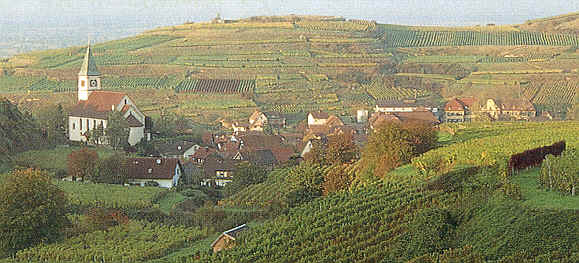
Endingen am Kaiserstuhl
Baden-Württemberg, Germany, circa 1995
Endingen is a town 40 kilometers (25 miles) north-west of Freiburg-im-Breisgau, at the northern foot of the Kaiserstuhl. The Böniz / Benitz family of Endingen was likely begun by Lorenz (Laurentius) Bonitz in the early 1700's. He came from Sankt Peter im Schwarzwald (Saint Peter in the Black Forest), a village 30 kilometers east of Freiburg. They spoke Badischen, the German dialect of Baden.
The Kaiserstuhl (Kaizer's Stool) is a picturesque protrusion of rolling green hills rising at the southern end of the flat farm lands between the Rhine River and the Black Forest (Schwarzwald). Endingen is today one of the larger villages which circle the Kaiserstuhl, an area which has produced wine since Roman times. With flat-lands facing it to the north, Endingen is surrounded by neatly tended hilly vineyards to its east, south, and west.
In old letters, Endingen was addressed as: Endingen-im-Breisgau, Grand Duchy of Baden. Today its correct reference is: Endingen-am-Kaiserstuhl, Baden-Württemberg, Germany. On this site, we most often refer to it as simply: Endingen.
————«♦»————
During the early 1800's, the Benitz's of Endingen were tradesmen: Wilhelm's father and grandfather were coopers (barrel-makers), while Alexander's father was a master tanner/dyer. In the following paragraphs, Dieter Joos of Ueberlingen, Germany, describes the typical social organization of an early 19th. century Baden village (per e-mail received 14 Aug'99):
The society of an common village in the area what is now called Baden - Wuerttemberg has rather sharply been separated into three classes: The first class were the wealthy farmers (ca 2-5 %) which possessed the big farms partly by their own but mostly by fief (?) (German = Lehen; Schupflehen, Erblehen) from a landlord or the church or a monastery. They also occupied the important village positions like prefect (German = Vogt), village judges etc. The second class were the common farmers ( ca 60-80 %). They possessed land also got by lief. This farmers worked hard but were usually able to earn so much as to guarantee a modest life for their families. The third class consisted of the day laborers (?) (German= Tageloehner) (ca 20-40 %). They worked for the other farmers for day wages. They possessed almost nothing and were very, very poor and had many many kids which died nearly all immediately after their birth.
To each of the three classes typical occupations were usually associated : The occupation of the upper class was that which brought most money: innkeeper. The occupations of the middle class were: smith, cartwright, cooper, tailor, shoemaker etc. The occupation of the lower class were weaver, ropemaker etc.
There was one profession which has to be considered separately: the millers. Generally they were rich often even very rich, but also they had a very bad moral image: first as it was said that they were all trickster (what surely comes near to truth) secondly as they were considered to be highly immoral. The last statement is based on the fact that the mills were generally located outside the village (towns: outside of the fortification walls). So this was the very place for events which no society loves to tolerates within its own walls. - (And alas, a considerable number of my ancestors were millers!)
What is important for family researchers is the fact, that penetrating the barriers of the social classes e.g. by marriage was nearly impossible. At the best a mixing only took place after disasters like war or plague. A consequence: all families within each class of a village and its neighbor villages (as long as they belonged to the same sovereign authority) are somewhat related. Good for finding relations, bad for separating the individuals. In a catholic village two third of all sons were named Johann or Jakob and two third of all daughters were named Maria or Anna. The rest was named after Saints especially the local ones. Sometimes kids are called after the landlord when this was a beloved one. But this did not occur very often.
Emigrants recruited mainly from the middle and lower class of the farmers. Upper class emigrants only show up when a farm has been handed over completely to one son (not too rare the youngest one!) and this heir gave to his brothers a stock for founding an new existence outside the village.
Remark: What I described is to some extent typical for the areas in southern Germany. Other places especially in Northern Germany have had in some details divergent rules.
In the following paragraphs, Rick & Sandy Schultz (e-mail received 1999) describe the trade of the barrel-maker, böttcher in German, cooper in English, and tonelero in Spanish:
Coopers were very common in the middle ages through the beginning of the 20th century. Food and beverages were normally stored in barrels. Since water was unsafe or questionable at best, people throughout Europe relied on beer and wine as the regular drink at meals. Of course, fresh milk was available on the farm or at the market. Since cooperage was so vital and so common, kegs were used for some dry goods and hardware instead of boxes.
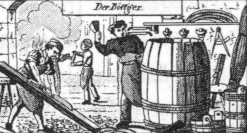
“Der Böttger”
from A Concise History of Germany
by Mary Fulbrook, Cambridge Univ. PressThere are two parts to coopering. The staves are wooden, usually oak. They must be curved inward. Steam was used to soften the wood, then it cooled while curved. But curving boards then trying to arrange them side by side does not work. They need to be beveled. Both ends must be narrower than the middle. The taper is not straight. It is curved. The amount of taper depends upon the length of the stave and the diameter of the barrel. Further, the edge at the middle of the board was nearly square while the ends were angled more. This was a skilled trade. Coopers developed the ability to trim staves with a hatchet free-hand. I do not think welting was used between the staves. The staves swell when damp and becomes naturally water-tight. The second aspect of the trade was hoop making. Hoops were copper or iron. You see where the name is from. The stave had a notch on the inside at both narrow ends. This was to seat the top and bottom. The coopers in a shop worked together to assemble the staves, ends and hoops into a barrel. The hoop was nailed in place or it might work itself loose over time. Some used heated hoops which were placed on the barrel and cooled with water. As they contracted, the keg became very secure.
© Peter Benitz (Benitz Family)